New Booster Seat Law Clarified by Texas Department of Public Safety

Booster Seat

Here’s another article on transportation of children that you might find interesting…if you have children…that you transport…or…if you are just a transportation law junkie:

There has been some confusion about a new state law that requires all children younger than eight (8) years old. UNLESS taller than 4’9″ to be in child passenger safety seat system. (“Child passenger safety seat system” includes traditional car seats with harnesses AND booster seats – both high-back and backless versions.)

The law also requires all safety seats and booster seats to be installed according to the instructions of the manufacturer of the safety seat system.

Because of the changes of the wording int he law (SB61), the following legal interpretation should be applied:

  • Once a child reaches eight (8) years old, they are not legally required to be in a child safety seat system.
  • If the child is younger than eight (8) years old, BUT they are already 4’9″ tall, they are not legally required to be in a child safety seat system.
  • If a child is eight (8) years old or older, and not yet 4’9″ tall, they are not legally required to be in a child safety seat system.

The law also requires that safety and booster seats be installed and used according to the manufacturer’s instructions, including age, height and weight requirements and the placement int he vehicle. (Some manufacturers prohibit using their products on the front seats of vehicles.)

The other part of the law that may cause some confusion are the dates of when the law takes effect and when the enforcement phase begins.

The law will take effect September 1, 2009. Law enforcement officers may only enforce the new changes in the law with written or verbal warnings until June 1, 2010.

However, beginning on June 1, 2010, officers may then arrest or issue a citation/notice to appear to a person committing an offense.

A fine of not more than $25 can be assessed for a first offense and no more than $250 for the second or subsequent offenses.

This extra time between the effective date and the written offense date is to allow parents and caregivers ample time to become educated about, and obtain, the required safety seats or booster seats.

Vehicle manufacturers design their products for adults – not kids – and they support keeping kids in the appropriate safety or booster seat until the child can properly wear the adult safety belt…typically when they reach 4’9″ tall.

Once your child has reached eight (8) years old, to know when they can wear an adult seat belt properly without a booster seat, use this simple test:

Have your child sit on the vehicle seat, sitting all the way back, with their back straight against the back of the seat, and buckle the lap/shoulder belt over them.

  1. Do their legs bend naturally at the knees over the edge of the seat?
  2. Does the lap portion of the belt fit low over the hips and top of their thighs?
  3. Does the shoulder portion of the belt fit across the center of their chest?

If the answer to any of these three questions is no, the child may be better protected in a booster seat.

A child in a poorly fitting adult seat belt usually slumps down, allowing the seat belt to ride up into their abdomen or neck, which can cause severe injuries to the child’s neck and internal organs during a car crash.

Although there is no law that prevents youngsters from sitting in the front seat of a vehicle, the safest place for a child in a car is in a rear seat, properly buckled into a child safety seat or a booster seat.

Air bags don’t replace child safety seats and may increase the risk of serious injury to children. Children younger than 13 should never ride int he front seats of vehicles with active passenger air bags. If you do have to transport a child int he front seat in an emergency – make sure the front seat is moved all the way back on the track, placing as much room as possible between the deployment is moved all the way back on the track, placing as much room as possible between the deployment zone of the air bag and the vehicle seat…but NEVER place a rear-facing safety seat on a front seat.

A final, but very important note: please read and follow the instructions in both the safety/booster seat owner’s manual AND the vehicle owner’s manual. Not all safety or booster seats fit the same in all vehicles – so you may have to try several before finding a good fit for your child and vehicle.

If you have any questions, please contact Beth Warren, DPS Administrative Training Unit, Safety Programs at 512/424-5639 or beth.warren@txdps.state.tx.us.
(You can find this article here.)

Car Seats and Children

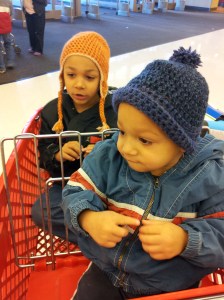
Boys at Target

Here’s an important message from the Texas Department of Public Safety. We wanted to make sure that we were following the Texas law concerning transporting our little ones. As you can see, this particular ride is safe as we are simply waiting for our Starbucks frappes at Target!

The American Academy of Pediatrics (AAP) issued new recommendations in their April 2011 publication, Pediatrics, addressing best practice when transporting children. This is not a change in Texas statute, however, parents and caregivers are encouraged to follow the new AAP Guidelines (PDF) when transporting children.

Hyperthermia (heat stroke/heat related) deaths: Last year there were 49 children in the US killed by hyperthermia (heat-stroke). Unfortunately, Texas led the nation with 13 of those deaths. never leave your child alone in a car, a Safe Kids Worldwide program, is dedicated to educating the public about this issue. For information on how you can prevent child hyperthermia deaths from occurring, visit Safe Kids.

The following presentations are designed to help answer questions that law enforcement officers and the general public may have concerning the changes to the child safety seat and occupant safety laws: 545.412 and 545.413:

Phase 1: Rear-Facing Seats – Infants: Birth – 35 pounds. Rear-facing infant or rear-facing convertible safety seat as long as possible, up to the rear-facing height or weight limit of the seat. Properly install rear-facing int he back seat.

Phase 2: Forward-Facing Seats – When children outgrow the rear-facing seat, they should ride in a forward-facing safety seat as long as possible, up to the upper height or weight limit (40-80 pounds) of the harnesses. Usually 4+ years old. Properly installed forward-facing int he back seat. NEVER turn forward-facing before 1-year-old AND 20-22 pounds.

Phase 3: Booster Seats – After age 4 and 40+ pounds, children can ride in a booster seat with the adult lap and shoulder belt until the adult safety belt will fit them properly (usually when the child is 4’9″ tall) MUST have a lap/shoulder belt to use a booster seat.

Phase 4: Adult Safety Belt – Once children outgrow their booster seat (usually 4’9″, 100 pounds) they can use the adult safety belt if it fits them properly. Lap portion low over the hips/tops of thighs and shoulder belt crosses the center of the shoulder and center of the chest.

Children are better protected the longer they can stay in each phase. Keep children in each seat up to the maximum age/weight/height limits before moving to the next phase.

For more information, contact Beth Warren, Occupant Safety Programs Coordinator at occupantsafety@dps.texas.gov or 512/424-5639.

(You can read this article here.)

The Laughter

Laughter, the best medicine!

The laughter is great! As my two sons run through the house you can hear the pitter patter of their feet. And the laughter: it’s contagious! They go on and wrestle with each other (as every little boy loves to do) right before they run and jump on me as I sit in the King’s Chair (that’s my leather chair with my leather ottoman). We watch Phineas & Ferb and Elijah will sit in the chair with me then Giovanni sits in the chair with us. I gotta tell you: WE NEED A BIGGER KING’S CHAIR!

Then the laughter hits. The show is funny but my two boys are hilarious. They laugh and laugh and laugh. You can’t help but join in with laughter. It’s not a contrived laughter. It’s genuine. It’s innocent. It’s coming right from the belly! My six-year-old imagines so big and describes in great detail what he sees in his mind’s eye and then he just laughs and laughs. My two-year-old speaks, too; I just can’t understand what it is that he’s saying, but he knows. Then he laughs and laughs.

In the mornings, when I am still asleep in bed, my six-year-old comes to my room and jumps on the bed and cuddles with me. Then comes in my two-year-old. He cuddles with me and big brother. Then they start hiding underneath the blankets and laugh and laugh. They wiggle and giggle and they go and go and go all over the king-sized bed exploring and imagining they are in a dark tunnel. Then Elijah attacks Giovanni and Giovanni screams and then laughs.

Then we call for breakfast. They run to the table to get their first boost of energizing food: “Something with sugar, pleeeeeeease!” As we eat they laugh. Giovanni is a slow eater, but he enjoys every part of his meals. Elijah eats like there’s no tomorrow. I sit and have my cup of coffee and Mom eats her breakfast. After we pray together as a family, then we talk and chatter and laugh and laugh.

At night-time, right before they go to bed, after their baths, we read a chapter from The Jesus Storybook by Sally Lloyd-Jones. Every chapter whispers Jesus’ name. And the boys are discovering that there is a Rescuer in the Person and Work of Jesus Christ. Elijah always knows that He is the Rescuer. Giovanni points at the illustrations and laughs and listens and slowly drifts to sleep. But before he falls asleep, we always pray together…then we laugh at something that one of us says…then we laugh some more…then they go to bed to sleep.

I wonder if they are laughing on the inside while they sleep. I remember as a kid I would dream funny dreams and my Dad and Mom told me that I laughed in my sleep. Now as a Dad, my Cheryl tells me that sometimes I still laugh in my sleep. My prayer is that my two sons will never lose their laughter. The laughter…priceless