President Richard M. Nixon’s Second Inaugural Address, January 20, 1973*

Nixon
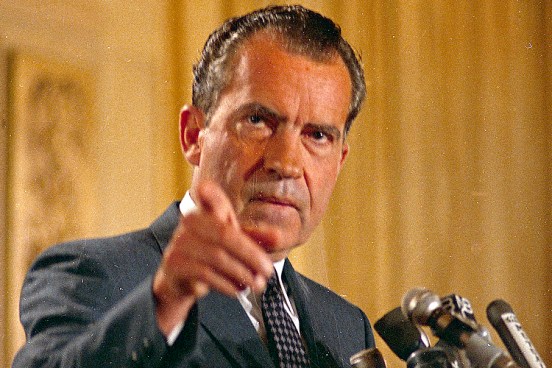
President Richard M. Nixon, 37th President of the United States of America, 1969-1974. Source: https://media.salon.com/2014/01/richard_nixon.jpg

I, RICHARD NIXON, do solemnly swear that I will faithfully execute the Office of President of the United States, and will to the best of my ability, preserve, protect and defend the Constitution of the United States, so help me God.

Mr. Vice President, Mr. Speaker, Mr. Chief Justice, Senator Cook, Mrs. Eisenhower, and my fellow citizens of this great and good country we share together:

When we met here 4 years ago, America was bleak in spirit, depressed by the prospect of seemingly endless war abroad and of destructive conflict at home.

As we meet here today, we stand on the threshold of a new era of peace in the world.

The central question before us is: How shall we use that peace?

Let us resolve that this era we are about to enter will not be what other postwar periods have so often been: a time of retreat and isolation that leads to stagnation at home and invites new danger abroad.

Let us resolve that this will be what it can become: a time of great responsibilities greatly borne, in which we renew the spirit and the promise of America as we enter our third century as a nation.

This past year saw far-reaching results from our new policies for peace. By continuing to revitalize our traditional friendships, and by our missions to Peking and to Moscow, we were able to establish the base for a new and more durable pattern of relationships among the nations of the world. Because of America’s bold initiatives, 1972 will be long remembered as the year of the greatest progress since the end of World War II toward a lasting peace in the world.

The peace we seek in the world is not the flimsy peace which is merely an interlude between wars, but a peace which can endure for generations to come.

It is important that we understand both the necessity and the limitations of America’s role in maintaining that peace.

Unless we in America work to preserve the peace, there will be no peace.

Unless we in America work to preserve freedom, there will be no freedom.

But let us clearly understand the new nature of America’s role, as a result of the new policies we have adopted over these past 4 years.

We shall respect our treaty commitments.

We shall support vigorously the principle that no country has the right to impose its will or rule on another by force.

We shall continue, in this era of negotiation, to work for the limitation of nuclear arms and to reduce the danger of confrontation between the great powers.

We shall do our share in defending peace and freedom in the world. But we shall expect others to do their share.

The time has passed when America will make every other nation’s conflict our own, or make every other nation’s future our responsibility, or presume to tell the people of other nations how to manage their own affairs.

Just as we respect the right of each nation to determine its own future, we also recognize the responsibility of each nation to secure its own future.

Just as America’s role is indispensable in preserving the world’s peace, so is each nation’s role indispensable in preserving its own peace.

Together with the rest of the world, let us resolve to move forward from the beginnings we have made. Let us continue to bring down the walls of hostility which have divided the world for too long, and to build in their place bridges of understanding–so that despite profound differences between systems of government, the people of the world can be friends.

Let us build a structure of peace in the world in which the weak are as safe as the strong, in which each respects the right of the other to live by a different system, in which those who would influence others will do so by the strength of their ideas and not by the force of their arms.

Let us accept that high responsibility not as a burden, but gladly–gladly because the chance to build such a peace is the noblest endeavor in which a nation can engage; gladly also because only if we act greatly in meeting our responsibilities abroad will we remain a great nation, and only if we remain a great nation will we act greatly in meeting our challenges at home.

We have the chance today to do more than ever before in our history to make life better in America–to ensure better education, better health, better housing, better transportation, a cleaner environment-to restore respect for law, to make our communities more livable–and to ensure the God-given right of every American to full and equal opportunity.

Because the range of our needs is so great, because the reach of our opportunities is so great, let us be bold in our determination to meet those needs in new ways.

Just as building a structure of peace abroad has required turning away from old policies that have failed, so building a new era of progress at home requires turning away from old policies that have failed.

Abroad, the shift from old policies to new has not been a retreat from our responsibilities, but a better way to peace.

And at home, the shift from old policies to new will not be a retreat from our responsibilities, but a better way to progress.

Abroad and at home, the key to those new responsibilities lies in the placing and the division of responsibility. We have lived too long with the consequences of attempting to gather all power and responsibility in Washington.

Abroad and at home, the time has come to turn away from the condescending policies of paternalism—of “Washington knows best.”

A person can be expected to act responsibly only if he has responsibility. This is human nature. So let us encourage individuals at home and nations abroad to do more for themselves, to decide more for themselves. Let us locate responsibility in more places. And let us measure what we will do for others by what they will do for themselves.

That is why today I offer no promise of a purely governmental solution for every problem. We have lived too long with that false promise. In trusting too much in government, we have asked of it more than it can deliver. This leads only to inflated expectations, to reduced individual effort, and to a disappointment and frustration that erode confidence both in what government can do and in what people can do.

Government must learn to take less from people so that people can do more for themselves.

Let us remember that America was built not by government, but by people; not by welfare, but by work; not by shirking responsibility, but by seeking responsibility.

In our own lives, let each of us ask-not just what will government do for me, but what can I do for myself?

In the challenges we face together, let each of us ask–not just how can government help, but how can I help?

Your National Government has a great and vital role to play. And I pledge to you that where this Government should act, we will act boldly and we will lead boldly. But just as important is the role that each and every one of us must play, as an individual and as a member of his own community.

From this day forward, let each of us make a solemn commitment in his own heart: to bear his responsibility, to do his part, to live his ideals–so that together we can see the dawn of a new age of progress for America, and together, as we celebrate our 200th anniversary as a nation, we can do so proud in the fulfillment of our promise to ourselves and to the world.

As America’s longest and most difficult war comes to an end, let us again learn to debate our differences with civility and decency. And let each of us reach out for that one precious quality government cannot provide–a new level of respect for the rights and feelings of one another, a new level of respect for the individual human dignity which is the cherished birthright of every American.

Above all else, the time has come for us to renew our faith in ourselves and in America.

In recent years, that faith has been challenged.

Our children have been taught to be ashamed of their country, ashamed of their parents, ashamed of America’s record at home and its role in the world.

At every turn we have been beset by those who find everything wrong with America and little that is right. But I am confident that this will not be the judgment of history on these remarkable times in which we are privileged to live.

America’s record in this century has been unparalleled in the world’s h!story for its responsibility, for its generosity, for its creativity, and for its progress.

Let us be proud that our system has produced and provided more freedom and more abundance, more widely shared, than any system in the history of the world.

Let us be proud that in each of the four wars in which we have been engaged in this century, including the one we are now bringing to an end, we have fought not for our selfish advantage, but to help others resist aggression.

And let us be proud that by our bold, new initiatives, by our steadfastness for peace with honor, we have made a breakthrough toward creating in the world what the world has not known before–a structure of peace that can last, not merely for our time, but for generations to come. We are embarking here today on an era that presents challenges as great as those any nation, or any generation, has ever faced.

We shall answer to God, to history, and to our conscience for the way in which we use these years.

As I stand in this place, so hallowed by history, I think of others who have stood here before me. I think of the dreams they had for America and I think of how each recognized that he needed help far beyond himself in order to make those dreams come true.

Today I ask your prayers that in the years ahead I may have God’s help in making decisions that are right for America, and I pray for your help so that together we may be worthy of our challenge.

Let us pledge together to make these next 4 years the best 4 years in America’s history, so that on its 200th birthday America will be as young and as vital as when it began, and as bright a beacon of hope for all the world.

Let us go forward from here confident in hope, strong in our faith in one another, sustained by our faith in God who created us, and striving always to serve His purpose.

Richard Nixon: “Oath of Office and Second Inaugural Address.,” January 20, 1973. Online by Gerhard Peters and John T. Woolley, The American Presidency Project. http://www.presidency.ucsb.edu/ws/?pid=4141.
President Richard M. Nixon’s First Inaugural Address, January 20, 1969*

richard-nixon-professional-photo-1
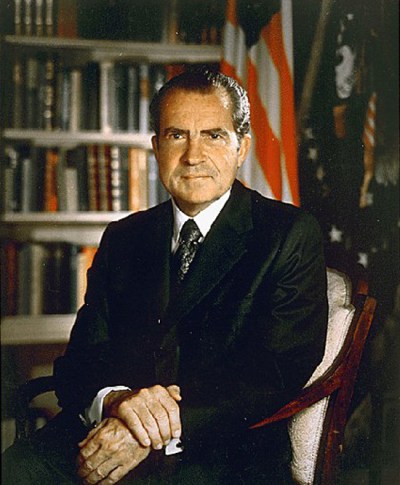
President Richard M. Nixon, 37th President of the United States of America, 1969-1974. Source: http://www.americanheritage1.com/assets/images/presidents/richard-nixon-professional-photo-1.jpg

Senator Dirksen, Mr. Chief Justice, Mr. Vice president, President Johnson, Vice president Humphrey, my fellow Americans-and my fellow citizens of the world community:

I ask you to share with me today the majesty of this moment. In the orderly transfer of power, we celebrate the unity that keeps us free.

Each moment in history is a fleeting time, precious and unique. But some stand out as moments of beginning, in which courses are set that shape decades or centuries.
This can be such a moment.

Forces now are converging that make possible, for the first time, the hope that many of man’s deepest aspirations can at last be realized. The spiraling pace of change allows us to contemplate, within our own lifetime, advances that once would have taken centuries.

In throwing wide the horizons of space, we have discovered new horizons on earth.

For the first time, because the people of the world want peace, and the leaders of the world are afraid of war, the times are on the side of peace.

Eight years from now America will celebrate its 200th anniversary as a nation. Within the lifetime of most people now living, mankind will celebrate that great new year which comes only once in a thousand years–the beginning of the third millennium.

What kind of a nation we will be, what kind of a world we will live in, whether we shape the future in the image of our hopes, is ours to determine by our actions and our choices.

The greatest honor history can bestow is the title of peacemaker. This honor now beckons America–the chance to help lead the world at last out of the valley of turmoil and onto that high ground of peace that man has dreamed of since the dawn of civilization.

If we succeed, generations to come will say of us now living that we mastered our moment, that we helped make the world safe for mankind.

This is our summons to greatness.

I believe the American people are ready to answer this call.

The second third of this century has been a time of proud achievement. We have made enormous strides in science and industry and agriculture. We have shared our wealth more broadly than ever. We have learned at last to manage a modern economy to assure its continued growth.

We have given freedom new reach. We have begun to make its promise real for black as well as for white.

We see the hope of tomorrow in the youth of today. I know America’s youth. I believe in them. We can be proud that they are better educated, more committed, more passionately driven by conscience than any generation in our history.

No people has ever been so close to the achievement of a just and abundant society, or so possessed of the will to achieve it. And because our strengths are so great, we can afford to appraise our weaknesses with candor and to approach them with hope.

Standing in this same place a third of a century ago, Franklin Delano Roosevelt addressed a nation ravaged by depression and gripped in fear. He could say in surveying the Nation’s troubles: “They concern, thank God, only material things.” Our crisis today is in reverse.

We find ourselves rich in goods, but ragged in spirit; reaching with magnificent precision for the moon, but failing into raucous discord on earth.

We are caught in war, wanting peace. We are torn by division, wanting unity. We see around us empty lives, wanting fulfillment. We see tasks that need doing, waiting for hands to do them.

To a crisis of the spirit, we need an answer of the spirit.

And to find that answer, we need only look within ourselves.

When we listen to “the better angels of our nature,” we find that they celebrate the simple things, the basic things–such as goodness, decency, love, kindness.

Greatness comes in simple trappings. The simple things are the ones most needed today if we are to surmount what divides us, and cement what unites us.

To lower our voices would be a simple thing.

In these difficult years, America has suffered from a fever of words; from inflated rhetoric that promises more than it can deliver; from angry rhetoric that fans discontents into hatreds; from bombastic rhetoric that postures instead of persuading.

We cannot learn from one another until we stop shouting at one another–until we speak quietly enough so that our words can be heard as well as our voices.

For its part, government will listen. We will strive to listen in new ways–to the voices of quiet anguish, the voices that speak without words, the voices of the heart–to the injured voices, the anxious voices, the voices that have despaired of being heard.

Those who have been left out, we will try to bring in.

Those left behind, we will help to catch up.

For all of our people, we will set as our goal the decent order that makes progress possible and our lives secure.

As we reach toward our hopes, our task is to build on what has gone before–not turning away from the old, but turning toward the new.

In this past third of a century, government has passed more laws, spent more money, initiated more programs than in all our previous history.

In pursuing our goals of full employment, better housing, excellence in education; in rebuilding our cities and improving our rural areas; in protecting our environment and enhancing the quality of life–in all these and more, we will and must press urgently forward.

We shall plan now for the day when our wealth can be transferred from the destruction of war abroad to the urgent needs of our people at home.

The American dream does not come to those who fall asleep.

But we are approaching the limits of what government alone can do.

Our greatest need now is to reach beyond government, to enlist the legions of the concerned and the committed.

What has to be done, has to be done by government and people together or it will not be done at all. The lesson of past agony is that without the people we can do nothing–with the people we can do everything.

To match the magnitude of our tasks, we need the energies of our people–enlisted not only in grand enterprises, but more importantly in those small, splendid efforts that make headlines in the neighborhood newspaper instead of the national journal.

With these, we can build a great cathedral of the spirit–each of us raising it one stone at a time, as he reaches out to his neighbor, helping, caring, doing.

I do not offer a life of uninspiring ease. I do not call for a life of grim sacrifice. I ask you to join in a high adventure–one as rich as humanity itself, and exciting as the times we live in.

The essence of freedom is that each of us shares in the shaping of his own destiny.

Until he has been part of a cause larger than himself, no man is truly whole.

The way to fulfillment is in the use of our talents. We achieve nobility in the spirit that inspires that use.

As we measure what can be done, we shall promise only what we know we can produce; but as we chart our goals, we shall be lifted by our dreams.

No man can be fully free while his neighbor is not. To go forward at all is to go forward together.

This means black and white together, as one nation, not two. The laws have caught up with our conscience. What remains is to give life to what is in the law: to insure at last that as all are born equal in dignity before God, all are born equal in dignity before man.

As we learn to go forward together at home, let us also seek to go forward together with all mankind.

Let us take as our goal: Where peace is unknown, make it welcome; where Peace is fragile, make it strong; where peace is temporary, make it permanent.

After a period of confrontation, we are entering an era of negotiation.

Let all nations know that during this administration our lines of communication will be open.

We seek an open world–open to ideas, open to the exchange of goods and people–a world in which no people, great or small, will live in angry isolation.

We cannot expect to make everyone our friend, but we can try to make no one our enemy.

Those who would be our adversaries, we invite to a peaceful competition–not in conquering territory or extending dominion, but in enriching the life of man.

As we explore the reaches of space, let us go to the new worlds together–not as new worlds to be conquered, but as a new adventure to be shared.

With those who are willing to join, let us cooperate to reduce the burden of arms, to strengthen the structure of peace, to lift up the poor and the hungry.

But to all those who would be tempted by weakness, let us leave no doubt that we will be as strong as we need to be for as long as we need to be.

Over the past 20 years, since I first came to this Capital as a freshman Congressman, I have visited most of the nations of the world. I have come to know the leaders of the world and the great forces, the hatreds, the fears that divide the world.

I know that peace does not come through wishing for it–that there is no substitute for days and even years of patient and prolonged diplomacy.
I also know the people of the world.

I have seen the hunger of a homeless child, the pain of a man wounded in battle, the grief of a mother who has lost her son. I know these have no ideology, no race.

I know America. I know the heart of America is good.

I speak from my own heart, and the heart of my country, the deep concern we have for those who suffer and those who sorrow.

I have taken an oath today in the presence of God and my countrymen to uphold and defend the Constitution of the United States. To that oath I now add this sacred commitment: I shall consecrate my Office, my energies, and all the wisdom I can summon to the cause of peace among nations.

Let this message be heard by strong and weak alike:

The peace we seek–the peace we seek to win–is not victory over any other people, but the peace that comes “with healing in its wings”; with compassion for those who have suffered; with understanding for those who have opposed us; with the opportunity for all the peoples of this earth to choose their own destiny.

Only a few short weeks ago we shared the glory of man’s first sight of the world as God sees it, as a single sphere reflecting light in the darkness.

As the Apollo astronauts flew over the moon’s gray surface on Christmas Eve, they spoke to us of the beauty of earth-and in that voice so clear across the lunar distance, we heard them invoke God’s blessing on its goodness.

In that moment, their view from the moon moved poet Archibald MacLeish to write: “To see the earth as it truly is, small and blue and beautiful in that eternal silence where it floats, is to see ourselves as riders on the earth together, brothers on that bright loveliness in the eternal cold–brothers who know now they are truly brothers.”

In that moment of surpassing technological triumph, men turned their thoughts toward home and humanity-seeing in that far perspective that man’s destiny on earth is not divisible; telling us that however far we reach into the cosmos, our destiny lies not in the stars but on earth itself, in our own hands, in our own hearts.

We have endured a long night of the American spirit. But as our eyes catch the dimness of the first rays of dawn, let us not curse the remaining dark. Let us gather the light.

Our destiny offers not the cup of despair, but the chalice of opportunity. So let us seize it not in fear, but in gladness-and “riders on the earth together,” let us go forward, firm in our faith, steadfast in our purpose, cautious of the dangers, but sustained by our confidence in the will of God and the promise of man.

Richard Nixon: “Inaugural Address,” January 20, 1969. Online by Gerhard Peters and John T. Woolley, The American Presidency Project. http://www.presidency.ucsb.edu/ws/?pid=1941.

President Lyndon B. Johnson’s Inaugural Address, January 20, 1965*

lyndon_b-_johnson2c_photo_portrait2c_leaning_on_chair2c_color_cropped
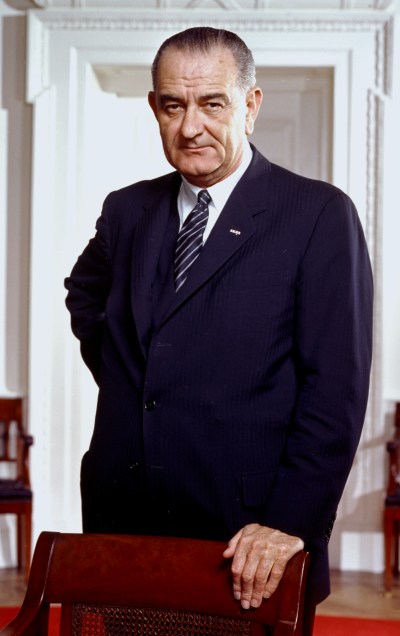
President Lyndon B. Johnson, 36th President of the United States of America, 1963-1969. Source: https://upload.wikimedia.org/wikipedia/commons/7/72/Lyndon_B._Johnson%2C_photo_portrait%2C_leaning_on_chair%2C_color_cropped.jpg

My fellow countrymen:

On this occasion the oath I have taken before you and before God is not mine alone, but ours together. We are one nation and one people. Our fate as a nation and our future as a people rest not upon one citizen but upon all citizens.

That is the majesty and the meaning of this moment.

For every generation there is a destiny. For some, history decides. For this generation the choice must be our own.

Even now, a rocket moves toward Mars. It reminds us that the world will not be the same for our children, or even for ourselves in a short span of years. The next man to stand here will look out on a scene that is different from our own.

Ours is a time of change–rapid and fantastic change–bearing the secrets of nature, multiplying the nations, placing in uncertain hands new weapons for mastery and destruction, shaking old values and uprooting old ways.

Our destiny in the midst of change will rest on the unchanged character of our people and on their faith.

THE AMERICAN COVENANT They came here–the exile and the stranger, brave but frightened–to find a place where a man could be his own man. They made a covenant with this land. Conceived in justice, written in liberty, bound in union, it was meant one day to inspire the hopes of all mankind. And it binds us still. If we keep its terms we shall flourish.

JUSTICE AND CHANGE First, justice was the promise that all who made the journey would share in the fruits of the land.

In a land of great wealth, families must not live in hopeless poverty. In a land rich in harvest, children just must not go hungry. In a land of healing miracles, neighbors must not suffer and die untended. In a great land of learning and scholars, young people must be taught to read and write.

For more than 30 years that I have served this Nation I have believed that this injustice to our people, this waste of our resources, was our real enemy. For 30 years or more, with the resources I have had, I have vigilantly fought against it. I have learned and I know that it will not surrender easily.

But change has given us new weapons. Before this generation of Americans is finished, this enemy will not only retreat, it will be conquered.

Justice requires us to remember: when any citizen denies his fellow, saying: “His color is not mine or his beliefs are strange and different,” in that moment he betrays America, though his forebears created this Nation.

LIBERTY AND CHANGE Liberty was the second article of our covenant. It was self-government. It was our Bill of Rights. But it was more. America would be a place where each man could be proud to be himself: stretching his talents, rejoicing in his work, important in the life of his neighbors and his nation.

This has become more difficult in a world where change and growth seem to tower beyond the control and even the judgment of men. We must work to provide the knowledge and the surroundings which can enlarge the possibilities of every citizen.

THE WORLD AND CHANGE The American covenant called on us to help show the way for the liberation of man. And that is today our goal. Thus, if as a nation, there is much outside our control, as a people no stranger is outside our hope.

Change has brought new meaning to that old mission. We can never again stand aside, prideful in isolation. Terrific dangers and troubles that we once called “foreign” now constantly live among us. If American lives must end, and American treasure be spilled, in countries that we barely know, then that is the price that change has demanded of conviction and of our enduring covenant.

Think of our world as it looks from that rocket that is heading toward Mars. It is like a child’s globe, hanging in space, the continent stuck to its side like colored maps. We are all fellow passengers on a dot of earth. And each of us, in the span of time, has really only a moment among our companions.

How incredible it is that in this fragile existence we should hate and destroy one another. There are possibilities enough for all who will abandon mastery over others to pursue mastery over nature. There is world enough for all to seek their happiness in their own way.

Our Nation’s course is abundantly clear. We aspire to nothing that belongs to others. We seek no dominion over our fellow man, but man’s dominion over tyranny and misery.

But more is required. Men want to be part of a common enterprise, a cause greater than themselves. And each of us must find a way to advance the purpose of the Nation, thus finding new purpose for ourselves. Without this, we will simply become a nation of strangers.

UNION AND CHANGE The third article is union. To those who were small and few against the wilderness, the success of liberty demanded the strength of union. Two centuries of change have made this true again.

No longer need capitalist and worker, farmer and clerk, city and countryside, struggle to divide our bounty. By working shoulder to shoulder together we can increase the bounty of all. We have discovered that every child who learns, and every man who finds work, and every sick body that is made whole–like a candle added to an altar-brightens the hope of all the faithful.

So let us reject any among us who seek to reopen old wounds and rekindle old hatreds. They stand in the way of a seeking nation.

Let us now join reason to faith and action to experience, to transform our unity of interest into a unity of purpose. For the hour and the day and the time are here to achieve progress without strife, to achieve change without hatred; not without difference of opinion but without the deep and abiding divisions which scar the union for generations.

THE AMERICAN BELIEF Under this covenant of justice, liberty, and union we have become a nation–prosperous, great, and mighty. And we have kept our freedom. But we have no promise from God that our greatness will endure. We have been allowed by Him to seek greatness with the sweat of our hands and the strength of our spirit.

I do not believe that the Great Society is the ordered, changeless, and sterile battalion of the ants. It is the excitement of becoming-always becoming, trying, probing, falling, resting, and trying again–but always trying and always gaining.

In each generation, with toil and tears, we have had to earn our heritage again. If we fail now then we will have forgotten in abundance what we learned in hardship: that democracy rests on faith, that freedom asks more than it gives, and the judgment of God is harshest on those who are most favored.

If we succeed it will not be because of what we have, but it will be because of what we are; not because of what we own, but rather because of what we believe.

For we are a nation of believers. Underneath the clamor of building and the rush of our day’s pursuits, we are believers in justice and liberty and in our own union. We believe that every man must some day be free. And we believe in ourselves.

And that is the mistake that our enemies have always made. In my lifetime, in depression and in war they have awaited our defeat. Each time, from the secret places of the American heart, came forth the faith that they could not see or that they could not even imagine. And it brought us victory. And it will again.

For this is what America is all about. It is the uncrossed desert and the unclimbed ridge. It is the star that is not reached and the harvest that is sleeping in the unplowed ground. Is our world gone? We say farewell. Is a new world coming? We welcome it, and we will bend it to the hopes Of man.

And to these trusted public servants and to my family, and those close friends of mine who have followed me down a long winding road, and to all the people of this Union and the world, I will repeat today what I said on that sorrowful day in November last year: I will lead and I will do the best I can.

But you, you must look within your own hearts to the old promises and to the old dreams. They will lead you best of all.

For myself, I ask only in the words of an ancient leader: “Give me now wisdom and knowledge, that I may go out and come in before this people: for who can judge this thy people, that is so great?”

Lyndon B. Johnson: “The President’s Inaugural Address,” January 20, 1965. Online by Gerhard Peters and John T. Woolley, The American Presidency Project. http://www.presidency.ucsb.edu/ws/?pid=26985.